|
|||||||||
|
|
|
|||||||||||||||||||||||||||||||||||||||||||||||||||||||||||||||
|
Jul 07 13:37
BEIJING (AP) -- Faced with my blank look of incomprehension, the taxi driver took a deep breath and tried again.
"Ha-pi-tu-mi-te-yu," he intoned.
Wow, I thought, six years out of Beijing and a long-haul flight from Europe have turned my once almost fluent Chinese to mush.
Then, it hit me. This was English. "'Happy to meet you?"' I asked.
He beamed proudly.
Give Beijingers this much: They sure want Olympic visitors to feel right at home.
In the seven years since the Olympic movement anointed Beijing as host of the 2008 Summer Games, China's capital has undergone a transformation so thoroughgoing that "makeover" doesn't begin to describe the change.
English-language and anti-spitting lessons for the masses. Entire neighborhoods ripped down and rebuilt. Cutting-edge Western architects let loose to create futuristic landmarks amid the forests of gleaming new towers. The ancient capital has taken on an edgy, neon-electric 21st-century frenetic feel.
You have to search harder, in back alleys that the wreckers' balls have yet to reach, for the quiet, intimate village-like atmosphere that long set Beijing apart from more cosmopolitan Hong Kong and Shanghai. In smoothing the rough edges, some charm has been lost.
First-timers and those who've not been here for a while may, like me, find the new Beijing a bit of a jolt. Who knew that the world had so many construction cranes, or produced so much concrete, glass and steel?
The shock of witnessing such voracious change leaves an unsettling feeling about whether the rest of the world can compete with a waking power as hungry as China. The immense scale on display seems designed to impress; the new Terminal Three at Beijing International Airport, where many travelers will arrive, is the world's largest.
The modernization makes Beijing easier to visit. Cash machines on many blocks. Cool art galleries in old Soviet factories. Hangouts for backpackers, swanky hotels for the well-heeled. Late-night shopping. More clubs than even the most insomniac reveler could get through in a weekend. Clean taxis. New buses. More subway lines. While the bicycle once ruled the roads, cars do now, and traffic is often snarled. If you're brave, rent a bike. The city's largely flat; you have nothing to lose but your chain.
The food: Don't miss a meal. Restaurants are plentiful and generally clean, offering all varieties of Chinese cuisine and many foreign ones -- a turnaround from a generation ago when food was scarce and eateries few and dingy. [See restaurant recommendations in this supplement.]
A nice touch: many now display color photos of their dishes. No more point-and-hope ordering from menus that often used to be only in Chinese, and far fewer comical English mistakes. A favorite from the old days: a hole-in-the-wall that served fried carp, but got the "a" and the "r" in the wrong order. Like many old haunts, it is now gone, replaced by a new office building.
For sightseeing, new landmarks compete for time and attention with older marvels, like the sprawling and ancient Forbidden City -- still a must-see.
The Olympic architectural jewel is the 91,000-seat, $450 million National Stadium. It's a knockout to look at. Bravo Switzerland-based architects Jacques Herzog and Pierre de Meuron. Beijingers call it the Bird's Nest because of the latticework of steel beams wrapped around the exterior. It will host the opening and closing ceremonies and track and field events.

Visitors without Olympic tickets will only be able to admire it from afar. Venues and the areas around them will be sealed off for the Aug. 8-24 games.
The massive security Chinese officials are rolling out poses an Olympic-sized question: will it kill off the fun, feel like prison, seeing guys in uniform across the city? Could be. If you are not coming for the sport or for the Olympic experience, August may not be the most relaxed period to visit.
The upside is that if a police officer does ask you to move on, there's a fair chance he'll be polite and understandable.
A pre-Olympic "Good Manners Campaign" promoted courtesy and orderly queuing and frowned on swearing, spitting and littering in public. One of the Beijing government's slogans, according to state media, was: "Spitting kills even more than an atomic bomb." Paper spit bags have been passed out. In three weeks here in May and June, I didn't hear anyone noisily clearing their throat in public -- a once common sound.
Beijing authorities have also given English lessons to 400,000 people, state media say. Most taxi drivers, hotel employees and all Olympic volunteers have received etiquette and English training. More than 10,000 police officers received basic work-related "police English" and even some Japanese, Russian and Arabic training.
If You Go...WEATHER: Beijing's summers are hot and humid, with average highs around 86 degrees and lows of 68 degrees. Rain is frequent and often heavy. METRO: Five lines run throughout the city; Line 10 takes you to Olympic venues while the Beijing Airport (L1) runs from Airport Terminals 2 and 3 into the city to the Dongzhimen metro stop (Line 2). TIANANMEN AND FORBIDDEN CITY TOURS: Exit Tiananmen East or West metro stops for Tiananmen Square and the Forbidden City, open from 8:30 a.m.-5 p.m. during the summer; tickets are $8.70 per person and half price for children and students. Audio tours are available for $6.80 with a $14.50 deposit. Tour Information. BICYCLE RENTALS & TOURS: www.utc88.com and www.cyclechina.com ECONOMY ACCOMMODATIONS: HIKING THE GREAT WALL: The best way to get to the Great Wall is with a tour group. The Badaling section is an hour drive outside of the city; tickets cost $6.80, open 6:30 a.m.-6 p.m. Mutianyu is 1.5-hour drive outside of Beijing; tickets cost $5, open 7 a.m.-6:30 p.m. A scenic and less crowded Great Wall experience is the four-hour-long Simatai to Jinshanling hike; a 2.5-hour drive outside of the city, it is open 5 a.m.-7 p.m. Tickets for Simatai cost $6.80, and $4.50) for Jinshanling. Tour Information. NATIONAL STADIUM: The National Stadium, also known as the Bird's
Nest, is a 30-minute taxi ride, if there is light traffic, or by the Line 10 metro from
downtown Beijing. Exit at the Olympic Park area. |
Among the phrases taught: "Welcome to Beijing, the host city of the 2008 Olympic Games. I recommend visiting the Great Wall; it is one of the seven wonders of the world."
Got that right. It was among seven new wonders of the world chosen in a global poll last year that elicited about 100 million votes via the Internet and text messages. The wall -- really a series of fortifications built over 1,500 years -- makes for an inspiring day out of the city. Take good shoes and water, so you can hike at least a little way from the crowds. Admire the way the wall hugs the hillsides as far as the eye can see. Take a bus or taxi there. [See travel guide recommendations in this supplement.]
The Badaling section is easiest to reach, and therefore the most crowded. Sections at Mutianyu or Jinshanling are farther away but offer more spectacular mountain scenery. Both have cable cars, for those for whom hiking is difficult or who maybe ate too much crispy Beijing duck the night before.
The Forbidden City is worth taking time over, too. Meander through its courtyards, some huge, others small and cozy, like secret gardens. Chinese emperors once lived shut off from the outside world behind the vast palace's blood-red walls, amid eunuchs and concubines. A detail to look out for: the fierce Chinese dragons finely embossed on the copper window frames of some of the palace buildings.
Then leap from concubines to communism, by walking through the front gate of the palace to Tiananmen Square, where five-starred red Chinese flags make snapping sounds when there's a strong breeze.
Mao Zedong gazes across the square from his portrait hanging on Tiananmen gate, at the north end, toward his mausoleum where his body lies encased in a glass coffin.
Tiananmen is a must-see for Chinese visiting Beijing. That makes it a great place to people-watch. Tibetan monks, ruddy-cheeked peasants from some far-flung village, southerners with singsong accents throng the square.
It's one place you may also attract stares. Foreigners are still novelties for out-of-towners from China's more remote regions. Not so for more worldly-wise Beijingers, who will likely be more than ha-pi-tu-mi-te-yu.
------
Associated Press Writer Chi-Chi Zhang contributed to this story.
Jul 07 14:02
China: New map, Zagat and Mobil guides, literary companion
Available @ Amazon |
NEW YORK (AP) -- The coming Olympic games in Beijing have spurred production of a slew of new guides to China. Along with books from most of the major travel publishers come four noteworthy new products, each offering readers a completely different experience: a literary companion, Mobil and Zagat guides, and a bilingual map.
"China: A Traveler's Literary Companion," edited by Kirk A. Denton (Whereabouts Press, $14.95), provides a way to see the country through fiction "that offers a strong sense of place," Denton says in his introduction. The stories, written from 1921 to 2003, range in setting from the mountains and streams of West Hunan, to silkworm-raising country and sorghum fields, to the high plateaus where Tibetan culture mingles with that of the Han Chinese. Other stories are set in the booming metropolises of Beijing, Shanghai and Hong Kong. Themes include the place of tradition in a modern society, changing values, poverty, the effects of globalization and identity.
If your interests run more to hotels and restaurants than literature, check out the new Mobil Travel Guide Beijing ($17.95). Mobil has been rating hotels, restaurants and spas since 1958, but this is the company's first guide to a city overseas. It lists must-sees, nightspots, places to stay and eateries. While none of Beijing's hotels received a five-star rating from Mobil, four received four-star ratings: the Grand Hyatt, the Peninsula, the St. Regis and the Shangri-La. A "best of the city" section in the front of the guidebook recommends, among other things, Peking duck at Li Qun or Dadong Roast Duck restaurants, shopping for original works of art at 798 Art District, martinis at Centro in the Kerry Centre Hotel, and a stroll through the Imperial Garden in the Forbidden City.
The Zagat Survey, best-known for restaurant guides based on reviews by diners, has also published its first-ever book on Beijing. The Zagat Beijing Survey ($15.95) includes dining, hotels, attractions, shopping and nightlife in the city. Series founders Tim and Nina Zagat, who are New Yorkers with a passion for authentic Chinese food, held a press briefing in Beijing in May to launch the book.
The VanDam map publishing company has produced a laminated, fold-out map of Beijing as part of its StreetSmart map series. Priced at $8.95, it's full color, extremely easy to read, includes place names in English and in Chinese characters, and shows neighborhoods, roadways and a subway map. It also has indexes for attractions, hotels and streets, along with separate maps for the Olympic Green and the Forbidden City. All 33 Olympic competition sites are marked with keyed symbols, and notable buildings and architecture are beautifully rendered in 3-D perspective. You can order the map from http://www.vandam.com. VanDam produces maps to destinations around the world. Its maps include the ArtSmart and ShopSmart series.
Jul 08 20:09
Where to Start?"There are more than 40,000 restaurants in Beijing, 90% of which are privately run -- a far cry from the few thousand state-owned eateries that were found on the streets during the early 1980s." -- He Zhifu, secretary-general of the Beijing Association for Food and Beverage Industries |
BEIJING (AP) -- My last houseguest had 13 restaurants on his to-try list, including three renowned for succulent versions of crisp-skinned Peking duck, one popular for its tongue-tingling Sichuan cuisine and a Uighur joint, known as much for the ethnic minority's cumin-spiced lamb skewers as its exuberant floor show.
"I never thought Beijing would have so many things!" he said hungrily after hours of online research.
Gone are the days when the traditional Chinese greeting "Have you eaten yet?" seemed like a bad joke in the dour capital where, as recently as the 1980s, staples were rationed, state-run canteens dished out the slop of the day in chipped enamel bowls and restaurants were few and far between.
Today's Beijing is packed with eateries at every corner, open at all hours and offering regional cuisines of all kinds -- a reflection of China's stunning economic success after almost three decades of convulsive growth.
And the run-up to the Aug. 8 Beijing Olympics has underscored the quantum leap in the quality and variety of fare on offer, with menus and manners being polished in anticipation of the crowd of 500,000 visitors during the games.
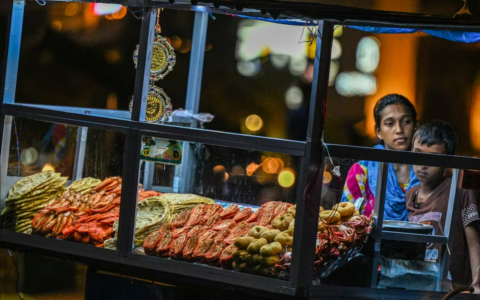
From al dente hand-pulled noodles splashed with bracing black vinegar from Shanxi province in the north, to fingernail-sized chicken pieces buried in a mountain of dried chilies from Sichuan in the southwest, to the rich, sweet braises of the east, there is something to pique every palate. Don't forget the street food -- handmade pork buns, candied fruit and egg, lettuce and crisp fried dough rolled in a freshly made flour crepe, a Chinese burrito of sorts.
And that's just from within the country.
Sushi and sashimi? Ocean fresh. Persian grilled meats and stews? In the heart of the city. Fish and chips? Beer-batter or breadcrumbs, take your pick. Greek, Vietnamese, Italian, German, French, Ethiopian, Spanish, Singaporean, even kosher ... the list goes on.
If You Go...Note: Local phone numbers are in parentheses. -- 1949, The Hidden City, Courtyard 4, Gongti Beilu, Chaoyang District, (65011949), http://www.elite-concepts.com/Promotions/1949/TheHiddenCity.htm -- Dadong Roast Duck Restaurant, 1-2/F, Nanxincang International Plaza, 22A Dongsishitiao, Dongcheng District (51690378, 51690329); Building 3, Tuanjiehu Beikou, Dongsanhuan Lu, southeast corner of Changhong Qiao, Chaoyang District (65822892, 65824003) -- Din Tai Fung, 24 Xinyuanxili Zhongjie, Chaoyang District, (65624502); 6/F, Shin Kong Place, China Central Place, 87 Jianguo Lu, Chaoyang District (65331536), http://www.dintaifung.com.tw/en/index.asp -- Fauchon, B1/F & 2/F, Shin Kong Place, 87 Jianguo Lu, Chaoyang District (65331266 ext. 8228), http://www.fauchon.com/ -- Green T. House, 6 Gongti Xilu, Chaoyang District (65528310, 65528311); 318 Hegezhuang Cun, Chaoyang District (84564922), http://www.green-t-house.com/ -- Guo Li Zhuang, 34B, Dongsishitiao, Dongcheng District (84035188); Room 40, Wangfa Market, Xisanqi, Haidian District (62719176) -- Le Pre Lenotre, 6/F, Sofitel Wanda Beijing, Building C, Wanda Plaza, 93 Jianguo Lu, Chaoyang District (85996666), http://www.sofitel.com/sofitel/fichehotel/gb/sof/6215/fiche--hotel.sh tml -- Whampoa Club, 23A Jinrong Dajie, Xicheng District (88088828) More Restaurant Recommendations
from the AP Beijing Bureau Staff |
"Simply put, we've gone from eating just to fill our stomachs to the stage where we are open to the complete pleasures of the dining experience," says Chitty Chung, editor-in-chief of Beijing's Food & Wine magazine.
That includes not only an awareness of a restaurant's environment, the chef's concepts, quality of service, the pairing of food and wine, and nutritional balance, but also a willingness try new things, says Chung, who recommends Dadong Roast Duck Restaurant not only for the namesake fowl, but also for its light modern twist on traditionally heavy Shandong fare.
"People's eyes are opening up and they are becoming more international. They are ready to accept and taste food from other parts of the world," she says. "The choices are far beyond your imagination."
So are the numbers.
There are more than 40,000 restaurants in Beijing, 90 percent of which are privately run -- a far cry from the few thousand state-owned eateries that were found on the streets during the early 1980s, says He Zhifu, secretary-general of the Beijing Association for Food and Beverage Industries.
They run the gamut from the simple (mom-and-pop dumpling place) to the showy (the starkly modern Green T. House, where dishes are decorated with curling tree branches, and the Whampoa Club, where roast spring onion ice-cream can be enjoyed in a dining room that sits beneath a massive glass goldfish pond) to the bizarre (Guo Li Zhuang which serves the penises and testicles of various animals -- dogs, yaks, ox -- cooked in a variety of ways.)
And some of the tastiest -- and most authentic -- regional treats can be found in the restaurants affiliated to the provincial government offices that have set up in the capital.
In all, Beijing's restaurants rake in more than US$4 billion annually and the revenues are still growing, a lucrative streak that has boosted the street cred of the city's food scene and drawn big names despite tainted product scares last year.
Chef Daniel Boulud -- a cult favorite in New York who has grabbed headlines for his US$150 ground sirloin burger filled with short ribs braised in red wine, foie gras and black truffles -- has just set up shop in a compound that used to house the U.S. Embassy. Le Pre Lenotre, sister restaurant of the three Michelin-star Le Pre Catelan in Paris, opened to great buzz in the Sofitel Wanda Beijing.
The also-very-French Fauchon is peddling its gourmet treats in a high-end mall and Philippe Starck designed the trippy, down-the-rabbit-hole Lan club and restaurant. Last month, Zagat, a global dining guide with a fierce hold on the American market, launched its Beijing edition.
"Beijing has a concurrence of circumstance at present," says Malcolm McLauchlan, general manager of 1949, The Hidden City, a cluster of ambitious restaurants overlooking the shady courtyard of a former factory.
He checked them off: a rapidly growing middle class, relatively little competition and Olympics-driven tourism.
Prior to the boom, the few and far between restaurants offered just a limited number of dishes. They opened late, closed early and were staffed by servers who seemed to take pride in being as disagreeable as possible. Their favorite phrase was "mei you," loosely translated to mean "we're out." Definitely no Haagen-Dazs, McDonald's or Starbucks.
State-run food stores offered a limited choice of essentials, like meat, flour, oil and eggs. Milk, yogurt, bread, bottled fruit and bai jiu -- China's version of moonshine -- were plentiful. But that's it.
"Now we can eat whatever we like without seasonal and geographical limitations," says Xu Yimin, editor-in-chief of Chinese and Foreign Food magazine, who lists the delicate but juicy dumplings of the Taiwanese chain Din Tai Fung as his favorite.
"Although food prices keep going up, peoples' love for tasty food hasn't changed," he said. "Eating has become a culture."
------
Associated Press Writer John Leicester contributed to the report.
Jul 08 20:10
|
Staff, past and present, of the Beijing bureau of The Associated Press share their favorite restaurants in the city. Addresses don't usually line up, so it's best to call the restaurant and hand the phone to your taxi-driver:
------
AUDRA ANG
Showcasing the spicy fare of Mao Zedong's home province of Hunan, the restaurant was opened by Fang Lijun, one of China's most influential contemporary artists. Enjoy some of his provocative pieces while chowing down on super-garlicky mashed eggplant served in a wooden bucket, cold beef rolls stuffed with cilantro and topped with a garlic puree, braised fatty pork and "swallow" dumplings bubbling in a flame-warmed broth. One dish that will impress any guest is an enormous steamed fish head topped with a pile of innocent-looking chopped green chilies. Don't be fooled, they will bring tears to your eyes. A tangle of boiled noodles will be brought to your table later to sop up the light soy sauce-based fish soup. Cool things down with a cold jug of plum juice.
Address: The alley next to the club Destination at the west gate of the Worker's Stadium, about 100 yards (meters) down, on left
Phone: 6551-0806
Cost: US$10 to US$15 per person
------
GREG BAKER
A warmly lit California-Japanese fusion joint popular with the hipster crowd. Super fresh sashimi and creative sushi rolls including one stuffed with Peking duck. Other tasty items are baked scallops in the shell topped with a sinfully cheesy sauce, miso cod and beef rolls with enoki mushrooms. Complimentary dessert.
Address: 2/F Heqiao Building, Guanghua Road, Chaoyang District
Phone: 6581-3939
Cost: US$20 to US$30 per person
------
ANITA CHANG
Hidden in a government compound behind the Chang'an Grand Theater, this restaurant dishes up arguably the best -- and spiciest -- Sichuan food in the capital. Forget wimpy Americanized versions and dive in if you dare. The chefs here are brought in from the mountainous southwestern province to cook for homesick civil servants and others who can handle the heat. A show-stopper is the laziji, a dish that is 10 percent chicken and 90 percent whole, dried red chili peppers served on a platter the size of an end table. Other must-eats are the pork dumplings doused in chili oil, cold glass noodles tossed with chili oil and tofu stir-fried with minced pork and -- what else? -- chili oil. Cool your mouth with bottles of cold Yanjing beer. Don't be shy about waving your arms frantically to flag down the less-than-attentive waitstaff and be prepared for long, long lines. It's worth it.
Address: Jianguomennei Avenue, walk 80 yards (meters) north on the street running alongside the Chang'an Grand Theater, take a right at the public bathroom. The restaurant is about 30 yards (meters) down on the left, inside the gated Sichuan provincial government compound
Phone: 6512-2277
Cost: US$10 to US$15 per person
------
ZHANG CHI-CHI
The beef tartare with parmesan potato souffle at this European-style restaurant is a must-try. It's moist and flavorful, topped with delicious herbs. The decor is modern, but unpretentious. W's comfortable surroundings draw in a good mix of locals and expats. Try the Italian citrus osso bucco with olive oil and herbs paired with a glass of wine from their impressive collection.
Address: 22-1 Dongzhimenwai Dajie
Phone: 6416-9838
Cost: US$20 to US35 per person
------
JOHN LEICESTER
Great dumplings, made with reddish sorghum flour that gives them an earthy taste and filled with tangy pickled vegetables. Dip them in sweet vinegar for added zing. The noodles here are great, handmade, beaten and spun in front of customers by quick-wristed chefs. Good spectacle. The thinly-sliced cold cooked pork is worth a try -- if nothing else for the accompanying crushed-garlic dip that trails on the tongue for days afterward.
Address (two locations): 20 Dawang Road and 3 Heping Xijie
Phone: 6774-9950 or 5130-9655
Cost: US$10 per person
------
ZHAO LIANG
If you want to get a sense of what it was like in a Beijing restaurant more than a century ago, this is the place to go. From outside, you can see big red lanterns hanging on the tile roof. Inside, you'll get an old-school greeting from waiters wearing mandarin-style jackets and black cloth shoes -- "Here you come! Please come on in!" They will show you to a marble table with four long red benches. According to a famous Chinese saying -- "Dragon meat in heaven, donkey meat on earth." Try some! And you must have the house specialty of noodles topped with a salty-sweet brown sauce. The constant bustle of the place means some smashed plates, but don't worry. Waiters will chorus "sui sui ping an" when that happens, which means that breaking something is a good omen for your health and safety.
Address: No.11, Zengguang Road, Haidian District
Phone: 8837-4993 or 8409-4929
Cost: US$7 to US$10 per person
------
JOE McDONALD
Cuisine of the ethnic minorities of China's southwestern province of Yunnan. Crowd-pleasers include pine-needle salad, spicy mint leaf salad with peppers, fried goat cheese, grilled fish and dishes based on the province's wide variety of mushrooms. Specialty drinks include distinctive homemade rice wine. The popularity of the restaurant has prompted the managers to open a shop next door selling delicacies such as pickled mushrooms.
Address: In the Yunnan provincial government representative office building at No. 7 Huashi North Road, Chongwen District
Phone: 6711-3322
Cost: US$10 to US$20 per person
------
SCOTT McDONALD
It's been called Chinese food 101, but you couldn't ask for a more picturesque introduction to homestyle cooking. Overlooking the small but busy Ritan Park, itself a gem of a find in one of the city's embassy districts, the restaurant's dishes are dependably good, even if they cater to more foreign palates. Crispy fried tofu, twice-fried green beans with pork, kung pao prawns and Peking duck are popular. A great place to take a date -- or your mother. After dinner, head to the Stone Boat for a drink. The cafe/bar on the west shore of Ritan's man-made pond is located in a stone boat evocative of Empress Ci Xi's famed vessel. Especially pleasant in summer, when a rotation of funky local bands take the stage.
Address: North gate of Ritan Park, take a left and walk about 100 yards (meters).
Phone: 8561-7859
Cost: US$20 to US$30 per person (and don't be shocked by the price of the fresh juices, which can hit almost US$30 per jug)
------
HENRY SANDERSON
The restaurant is cozily set in a quiet converted courtyard house off a small alleyway near Beijing's ancient Drum Tower. The intmate atmosphere is heightened by the house's full bookshelves, dark wooden furniture and seating under the stars. The set menu transports you to the mountainous region of Dali in southwest Yunnan, home of the Bai and Yi minorities. The lemongrass roasted tilapia and fried beef with mushrooms stand out, but the menu often changes. Waiters will ask if there's anything you don't eat and the food will be adapted accordingly. Generous glasses of wine.
Address: 67 Xiaojingchang Hutong, Gulou Dongdajie, Dongcheng District
Phone: 8404-1430
Cost: US$12 per person for the set menu
------
DIDI TANG
A block-long street lined with food stalls, offering munchies from sugarcoated fruit to fresh coconuts to Beijing-style baked pastries. And bugs. Lots of bugs on a stick. Follow the aromas, give in to the sales pitches of friendly food vendors and experience firsthand what Beijingers like to snack on. Bragging rights are all yours when you get home.
Address: North of the Wangfujing shopping area, at the end of the pedestrian street
------
TINI TRAN
An atmospheric courtyard restaurant located along Beijing's famous food street, Gui Jie, with its trademark red lanterns. It serves up new takes on tasty homestyle dishes, such as spicy crayfish and eggplant with abalone. They also make a deliciously crispy Beijing duck, with less fat than usual. The place is crowded and noisy but enthusiastic diners attest to the food's authenticity.
Address: .235 Dongzhimennei Dajie
Phone: 6405-1908
Cost: US$10 to US$15 per person
------
XI YUE
Literally translated, the name means "eat the Tang Dynasty." Located in a quiet corner of southeast Beijing, the restaurant serves food from the ancient capital city of Xi'an. Try pao mo (pow mwoh), a hot stew of chopped up steamed bread and glass noodles in lamb broth, served with chunks of lamb meat. Best accompanied by pickled garlic and chili sauce. Also good are the translucent liang pi (lee-ahng pee) noodles and the Qi Shan (chee shahn) noodles, a spicy concoction with diced vegetables and meat. The secret ingredient? Qi Shan vinegar, which gives it an extra kick. Wash it all down with Huang Gui (hwang goo-wei) rice wine which, according to legend, was the favorite of Yang Guifei, the most beautiful princess of the Tang dynasty. People say the wine can make women prettier.
Address: Jing Song No. 9 district, building 907
Phone: 6776-9193
Cost: US$5 per person
View Today's Featured Recipe
[Opens a New Browser Window]
[Back to Asian-American Village Home]
|
IMDiversity.com is committed to presenting diverse points of view. However, the viewpoint expressed in this article is the opinion of the author and is not necessarily the viewpoint of the owners or employees at IMD. |
|